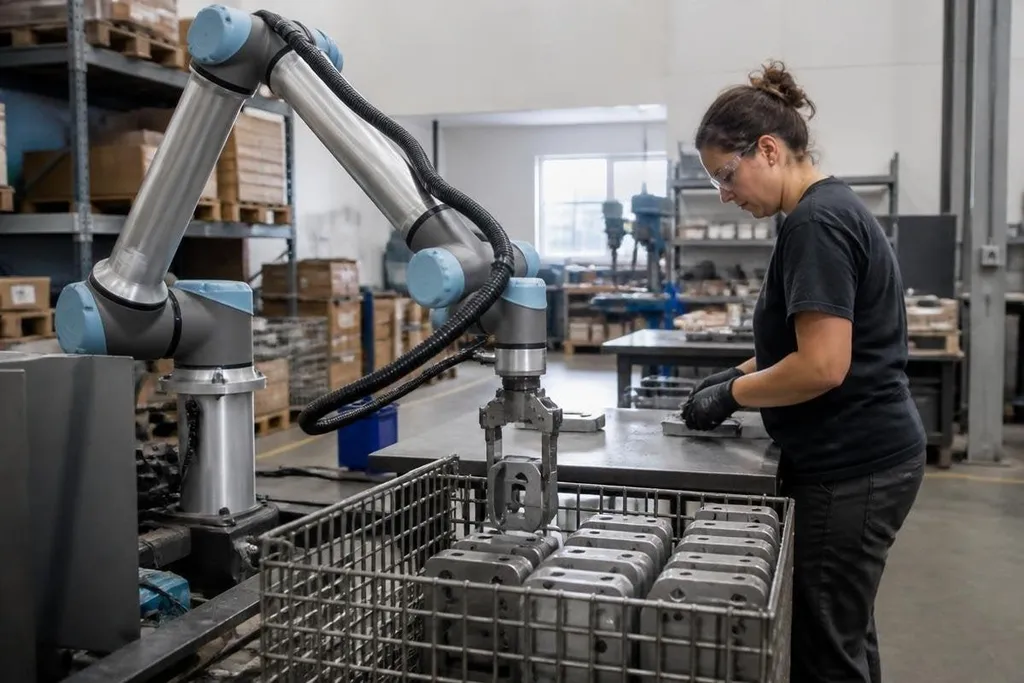
One small factory can now automate one step without rebuilding its whole site. A barcode scanner, a basic controller, or a small robotic arm can remove a repeated task while people handle the work that still needs judgment.
That changes the buying question for an owner with a tight budget. You don't need a fully automated plant; you need one task where the cost, delay, or error rate is easy to see.
Start with one repeated task
Large automation projects often begin with a small process that runs every day. A worker may scan the same label, move the same part, check the same measurement, or enter the same order data for hours at a time.
Those tasks give a smaller company a clear place to start. A scanner can send a product code to inventory software. A camera can check whether a part is present. A robotic arm can load a machine or place items in a box when the parts arrive in a fixed position.
The benefit comes from the task's shape. Work that repeats in the same order is easier to automate than work that changes with every job, so the first project should have few exceptions and a clear result.
Why the cost has changed
Automation used to mean a large custom system, a long installation, and a dedicated engineering team. Smaller equipment and subscription software have widened the range of projects a company can consider.
A business can buy a sensor, controller, conveyor, or cobot for one work area. A cobot is a robot designed to work near people under defined safety limits. It may handle loading or packing while a worker supplies parts and checks the output.
The hardware still needs setup. The lower price does not remove safety checks, worker training, maintenance, or the need to connect the equipment to existing software.
It does make a staged purchase possible, where the company proves one task before adding another.
A staged purchase still needs proof that the supplier’s machine works outside a demo. Dated robotics reporting can tie the machine to a named company and work site, so you can judge the software claim that follows.
The software matters as much as the robot
A robot that moves parts but cannot report what it did creates another manual task. The useful system connects the machine to the records people already use for stock, orders, quality checks, or maintenance.
That connection may use a programmable logic controller, known as a PLC, to read sensors and control motors. It may also use a local computer or cloud dashboard to show stopped machines, completed jobs, and faults.
Data does not fix a weak process by itself. Before buying equipment, map the current steps and record where delays occur. That gives you a way to check whether the new system changes the work instead of adding another screen to watch.
Where smaller firms can run into trouble
The first risk is choosing a machine before choosing the task. A robot may look useful in a demonstration but struggle with loose parts, changing product sizes, poor lighting, or a gripper that cannot hold the item safely.
The second risk is ignoring the people who do the work now. They know which parts arrive damaged, which orders change at short notice, and which sensor position will collect dust. Their input can prevent a costly redesign.
Maintenance also needs a named owner. Someone must clean sensors, replace worn gripper parts, check cables, and respond when the machine stops. If that work has no place in the weekly plan, the system may spend more time waiting for help than doing its task.
A buying checklist for a first project
Use this list before asking for quotes:
- Name the task: write down the repeated step, its start point, and its finished result.
- Count the exceptions: record how often the process changes, stops, or needs a person to decide.
- Check the input: confirm that parts, labels, lighting, and data arrive in a form the equipment can read.
- Price the full job: include safety equipment, software, training, service, spare parts, and installation.
- Set a pass mark: choose the error rate, output level, or staff time the project must reach.
- Plan the fallback: decide how work continues if the robot, network, or sensor stops.
I'd start with the task that wastes the most paid time and has the fewest surprises. A small project that works gives you measured proof for the next purchase; a large project built on guesses gives you a large bill first.